


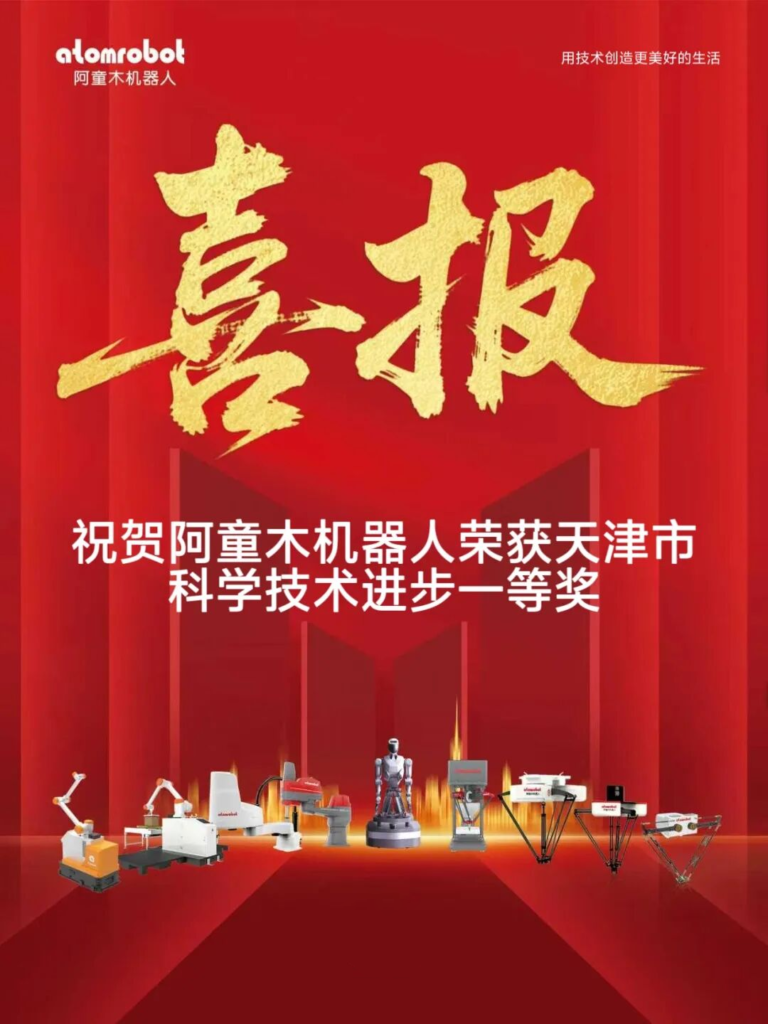
Recently, the Tianjin Municipal People’s Government officially released the list of winners of the 2025 Tianjin Science and Technology Awards. ATOMROBOT, with its project “Key Technologies and Applications of High-Speed Delta Robot Industrialization”, has been awarded the First Prize of Tianjin Science and Technology Progress Award.
This is more than a certificate—it is a high-level recognition of the company’s 13 years of continuous dedication to core technology breakthroughs.
Footprints
For professionals familiar with China’s science and technology system, the weight of the “Tianjin Science and Technology Progress First Prize” is self-evident.
According to the Tianjin Science and Technology Awards Regulations, the award is strictly granted to organizations and individuals that achieve major technological innovation, successful commercialization, and significant economic benefits in technology development projects.
This means ATOMROBOT’s achievement has passed a dual rigorous evaluation: technological advancement + real-world commercial impact.
In the 2025 selection process, numerous universities, research institutes, and large state-owned enterprises competed side by side. Standing out in such intense competition is itself an official certification of both technological strength and commercial value.
Behind this honor lies years of persistent efforts by ATOMROBOT to tackle a critical “bottleneck” technology area.
ATOMROBOT founder and chairman Liu Songtao recently stated in an interview with Tianjin TV:
“ATOMROBOT’s industrial innovation and breakthroughs will drive technological progress across the upstream and downstream industrial chain, forming a healthy industrial ecosystem and truly integrating technological innovation with industrial innovation.”
Breakthrough
Handling robots are core equipment in automated production lines, responsible for material transfer, sorting, and packaging.
As industrial manufacturing shifts from large-scale standardized production to customized mixed production, demands for cycle time and flexibility have increased significantly. High-speed handling robots have become a necessity.
However, the global high-speed Delta Robot market has long been dominated by foreign giants such as ABB and FANUC. Although the Delta Delta Robot architecture originated abroad, its core technologies have remained tightly controlled overseas.
To break this monopoly, domestic robotics must achieve full-chain breakthroughs in:
- product portfolio design
- core component manufacturing
- commercial controller development
- application expansion
For example, in the dairy industry—an over 250 billion RMB market—production has long relied on manual labor, making it an ideal entry point for transformation.
Against this backdrop, ATOMROBOT partnered with Tianjin University and others to launch the project “Key Technologies and Applications of High-Speed Delta Robot Industrialization”, initiating a full-scale technological breakthrough.
Innovation
Developing internationally competitive high-speed Delta Robot product series and achieving large-scale deployment across industries is a highly challenging task.
After years of R&D, the ATOMROBOT team achieved breakthroughs in three key areas:
Innovation 1: Product platformization and manufacturing
The first challenge in industrialization is building a standardized product family and core component system.
Different industries require vastly different workspace ranges, payload capacities, and cycle times. The challenge lies in:
- reducing manufacturing cost and part variety
- meeting customized requirements
- enabling low-cost mass production
Through systematic research, the team developed a product family of 5 series and 41 specifications.
Key performance:
- max payload: 25 kg
- minimum cycle time: 0.18 s
- max working range: 2800 mm
Through digital manufacturing and flexible assembly, the system achieves both variety and mass production efficiency.
This innovation resulted in:
- 4 invention patents
- 11 utility model patents
- 1 national standard
- 15 academic papers
Innovation 2: Integrated drive-control technology
Whether servo drive and control systems are independently controllable is critical to industrial success.
Traditional “controller + general servo drive” architectures suffer from:
- low integration
- poor stability
- communication delay
- high energy consumption
Additionally, performance is affected by changing inertia loads and vibration during high-speed motion.
ATOMROBOT broke through this limitation by developing an integrated drive-control architecture, including:
- proprietary drive-control controller (CE certified)
- high-speed stable motion control algorithms
Performance improvements:
- stabilization time reduced to 0.03 s
- significantly reduced residual vibration
- positioning accuracy up to 0.01 mm
This enables robots to achieve both high speed and high precision simultaneously.
This innovation resulted in:
- 14 invention patents
- 6 utility model patents
- 12 software copyrights
- 16 academic papers
Innovation 3: Flexible reconfigurable production line technology
In automated production lines, accuracy, efficiency, and reliability determine competitiveness.
Key challenges include:
- randomly stacked materials requiring high recognition ability
- dynamic multi-robot task coordination
- highly customized production line layouts
ATOMROBOT developed:
- high-speed recognition and positioning (20 ms processing time)
- 99.99% recognition accuracy
- ±0.5 mm positioning accuracy
It also introduced:
- dynamic scheduling algorithms
- multi-robot collaboration systems
- modular production line architecture
This enables fast reconfiguration of production lines to adapt to changing demands.
This innovation resulted in:
- 4 invention patents
- 20 utility model patents
- 6 software copyrights
- 12 academic papers
Implementation
Honor belongs to the past, but the awarded technologies are already creating real value in thousands of factories.
For ATOMROBOT, this award is not just a medal, but a benchmark that defines its commitment to products, services, and customers.
As an internationally recognized brand:
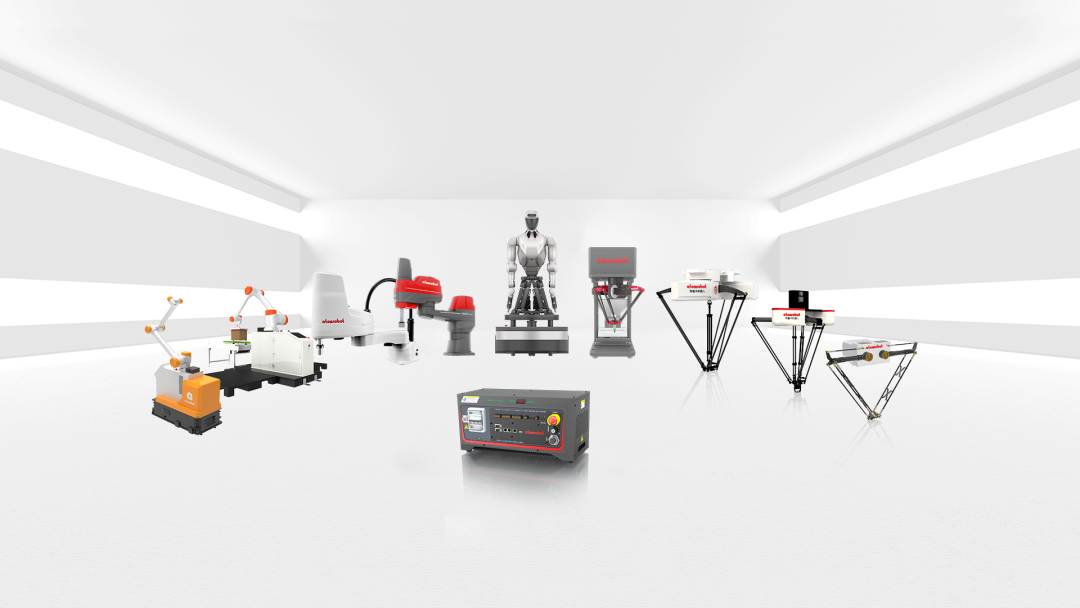
- 5 product series and 41 specifications are now fully commercialized
- applicable to food, pharmaceutical, daily chemical, automotive, and new energy industries
- award-winning technologies have been fully integrated into mass-produced products
This means every ATOMROBOT machine now includes officially validated advanced technologies and control algorithms.
Based on real-world deployment experience, ATOMROBOT has built a full lifecycle service system covering:
- process development
- production line design
- remote maintenance
Service commitment:
- 1-hour response
- 24-hour on-site arrival
- 72-hour problem resolution
ATOMROBOT currently serves:
- 1000+ enterprises in China
- exports to 30+ countries
These numbers represent real improvements in productivity, cost reduction, and competitiveness.
This stems from ATOMROBOT’s mission:
“Use technology to create a better life.”
Every high-speed pick, every precise placement, contributes to more efficient production, safer workplaces, and higher-quality products.
But the company’s vision never stops at past achievements.
From Awards to the Future
Entering the deep waters of embodied intelligent manufacturing
Standing at the starting point of the Tianjin Science and Technology Progress First Prize, ATOMROBOT sees not only its past achievements but also its future journey.
In the era of “Made in China”, individual breakthroughs are converging into industry-wide transformation. As a solution provider in the upstream of the industrial chain, every technological iteration directly enhances downstream manufacturing competitiveness.
This award is not only recognition of ATOMROBOT’s “geek spirit”, but also a boost of confidence for the entire domestic robotics industry.
ATOMROBOT will continue focusing on:
- robot control algorithms
- industrial applications
And its vision is already set further ahead.
Embodied intelligence evolution
In 2025, ATOMROBOT launched Tianjin’s first embodied intelligent robot “Tianbing No.1”, the world’s first humanoid robot based on a parallel mechanism.
Key features:
- Stewart parallel waist structure for rigidity + flexibility
- 7-axis symmetric humanoid force-controlled arms
- lightweight integrated joints with quick maintenance
- interchangeable end effectors (two-finger gripper / five-finger dexterous hand)
- 170 TOPS computing power (NVIDIA CUDA GPU + ARM CPU architecture)
- multi-modal sensor system enabling 360° perception
- omnidirectional mobile base with zero turning radius
- laser SLAM + vision fusion for millimeter-level navigation
Currently, Tianbing No.1 is mainly used in:
- university research labs
- chemical laboratories
- enterprise training bases
- data collection centers
- smart computing rooms
From Delta Robots to embodied intelligence, from dedicated applications to general-purpose capabilities, ATOMROBOT continues to embed its mission—“using technology to create a better life”—into every iteration.
In the future, together with partners, ATOMROBOT will continue advancing China’s robotics industry toward the mid-to-high end of the global value chain, showcasing the strength of Chinese intelligent manufacturing to the world.